
How to Use LinkedIn to Land Director-Level Roles in Tech
For many technology leaders, LinkedIn feels like a frustrating paradox.
You may have 15-20 years of experience, have built high-performing teams, and delivered products used by millions of users. Yet when you begin looking for your next role, you encounter the same pattern:
● Applications disappear into a void
● Recruiters stop responding
● Opportunities seem scarce
The issue usually isn't your qualifications.
It's that LinkedIn, the most powerful career tool available to senior leaders, is often working against you instead of for you.
When used strategically, LinkedIn can help you access what many refer to as the hidden job market: the large percentage of leadership roles filled through referrals, relationships, and direct outreach before a public job posting ever appears.
Below is a practical framework for using LinkedIn to position yourself for Director-level roles and above in technology leadership.
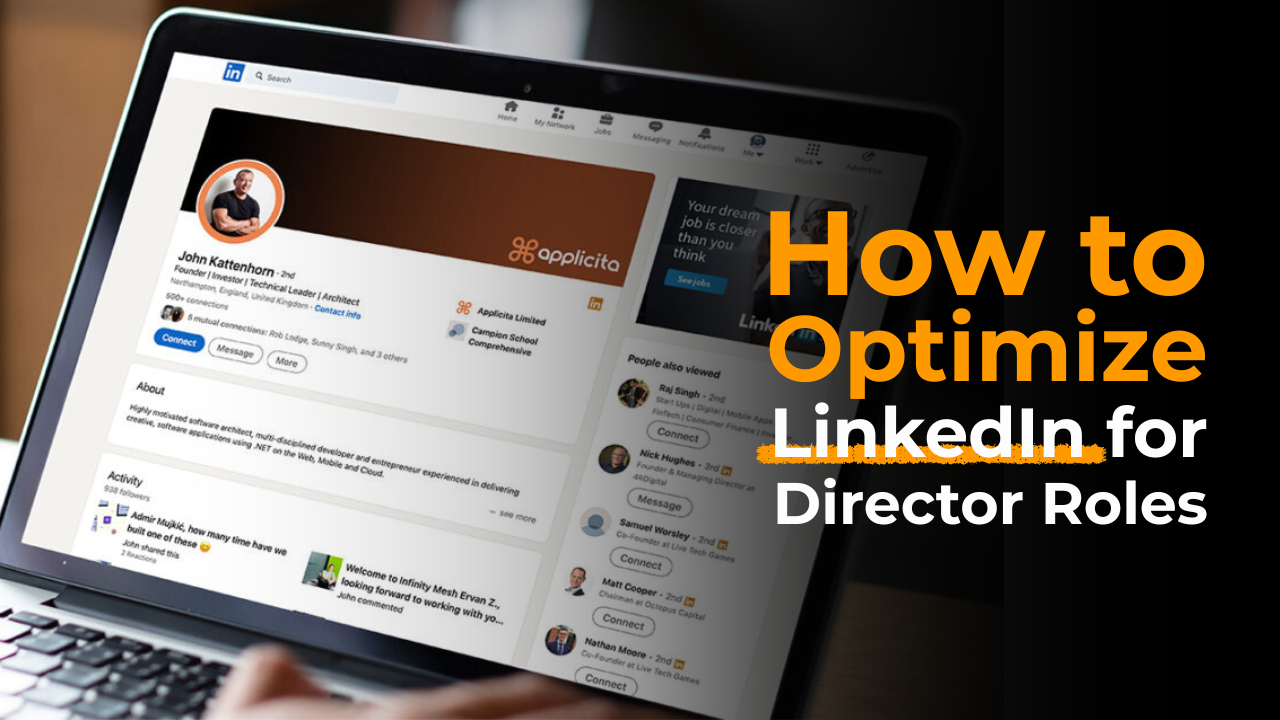
Many senior leaders underestimate how LinkedIn actually functions behind the scenes.
LinkedIn is not simply a social network or an online resume. It operates as a search engine for talent.
Recruiters and hiring leaders typically use LinkedIn Recruiter (the paid enterprise version of the platform) to run highly filtered searches. They narrow candidates by criteria such as:
● Job titles
● Skills
● Industry experience
● Keywords embedded across profiles
If your profile does not contain those signals, you may never appear in their search results, even if you are an ideal candidate.
Your LinkedIn profile ultimately has two core jobs:
1️⃣ Show Up in Searches
Recruiters cannot reach out to you if your profile isn't discoverable. This means your profile must contain the right keywords, titles, and skills for the roles you want.
2️⃣ Turn Profile Views Into Conversations
When recruiters run a search, they often scan dozens or even hundreds of profiles. They are not reading each one carefully. Instead, they look for quick signals that answer one question: Is this person relevant for the role I’m trying to fill?
Your profile must communicate your value quickly and clearly.
Step 1: Optimize Your LinkedIn Headline
Your headline is one of the most important pieces of real estate on LinkedIn.
It appears in search results, connection requests, comments, messages, and profile previews.
Yet, many professionals default to a headline like:
Director of Engineering at [Company]
While accurate, this misses a major opportunity.
A stronger headline includes both searchable keywords and a differentiator. For example:
Director of Engineering | Scaling High-Performance Cloud Infrastructure Teams
Engineering Director | AWS, Kubernetes, Platform Engineering | 0→1 Product Builds
Director of Data Engineering | Snowflake, dbt, Kafka | Turning Data Into Revenue Insights
Each of these examples communicates:
● The role
● The technical domain
● The impact
This makes the profile far more compelling when it appears in search results.
Step 2: Write an About Section that Highlights Your Value
The About section is where many profiles lose momentum. Too often it begins with generic language like:
Experienced engineering leader passionate about technology and innovation.
That sentence could describe thousands of professionals.
Instead, your About section should clearly communicate your value proposition. Here's a simple structure that accomplishes this:
🧩 Who You Are
Your role, industry focus, and the types of organizations you support.
🧩 What You Do
The outcomes you help companies achieve.
🧩 Your Core Strengths
Leadership capabilities, technical expertise, or organizational strengths.
🧩 A Defining Achievement
A concrete example that proves your impact.
For example:
I'm a Director of Data Engineering specializing in helping growth-stage tech companies build scalable data infrastructure using AWS, Snowflake, and dbt.
I lead teams that design platforms enabling faster analytics, improved product decisions, and real-time machine learning applications.
My strengths include building high-performance engineering teams, modernizing data pipelines, and aligning technical strategy with business outcomes.
Recently, I led a platform migration that reduced data pipeline latency by 70% and enabled real-time ML feature delivery for a 200-engineer organization.
Clarity builds credibility, and credibility drives conversations.
Step 3: Strengthen Your Experience Section
Your Experience section is one of LinkedIn's most searchable areas.
Recruiters often filter candidates based on the keywords found in job descriptions within profiles.
To maximize impact, structure each role carefully.
🧩 Lead With Scope
The first bullet in every role should describe the scale of your responsibilities.
Example:
Led a team of 25 engineers responsible for a cloud platform serving 3 million users.
🧩 Use the Situation–Action–Result Framework
Every major accomplishment should communicate context, the action you took, and its measurable outcome.
Example:
Re-architected core microservices infrastructure, reducing system latency by 40% and improving uptime to 99.99%.
🧩 Include Metrics Frequently
Numbers stand out immediately in scanning because metrics signal real impact. Strong examples include team size, revenue impact, performance improvements, and cost reductions.
Step 4: Use the Skills Section Strategically
LinkedIn allows up to 100 skills on a profile.
For Director-level leaders, the right balance of skills is important.
Your profile should include both:
🧩 Leadership Skills
● Engineering leadership
● Organizational development
● Cross-functional leadership
● Team scaling
● Strategic planning
🧩 Technical Domain Skills
● Cloud architecture
● Kubernetes
● Data platforms
● Machine learning infrastructure
Technical skills establish credibility, but leadership capabilities signal readiness for executive roles.
Also make sure skills are attached to roles within your experience section, which strengthens their visibility in recruiter searches.
Step 5: Configure "Open to Work" Strategically
Once your profile is optimized, you can signal to recruiters that you're open to opportunities.
However, it's important to configure this correctly.
Instead of listing just one title, include variations such as:
● Director of Engineering
● Director of Software Engineering
● Head of Engineering
● VP of Engineering
This broadens the search results where your profile appears.
Also, avoid the public "Open to Work" banner. Set your profile to "Recruiters Only" to ensure recruiters can see your availability while maintaining professional positioning.
At the Director level and above, subtle signaling is usually more effective.
The LinkedIn Networking Strategy that Unlocks the Hidden Job Market
Optimizing your profile is only the first step.
The real leverage comes from strategic networking.
Research consistently shows that 70-80% of roles are filled through relationships and referrals, especially at senior levels.
To expand your network intentionally, focus on three groups.
🧩 Peers: Other leaders at your level within companies you respect. Peers often become referral sources when positions open internally.
🧩 Decision-Makers: These individuals often create and approve roles, making relationships here extremely valuable. Examples include VPs of Engineering, CTOs, Product leaders, General Managers.
🧩 Internal Advocates: Professionals who influence hiring decisions, such as HR business partners, Product leaders, and Senior engineers. Advocates can elevate your name during internal discussions.
Now, many LinkedIn outreach messages fail because they focus on the sender.
A typical message might say:
I'd love to connect and explore potential opportunities.
This rarely generates engagement because it's about you and your needs.
Instead, structure your outreach around:
● Context
● Relevance
● A simple ask
For example:
Hi [Name], I saw your recent post about scaling backend infrastructure teams in hybrid environments. We've been tackling similar challenges at my current company. I'd enjoy connecting and exchanging notes if you're open to it.
This approach shows genuine interest, demonstrates shared experience, and creates an easy reason to respond.
FAQs about Optimizing LinkedIn for Senior Leaders
How often should I post on LinkedIn as a Director?
Quality and consistency matters more than frequency. Posting once or twice per month with thoughtful insights can significantly increase visibility among peers and recruiters.
Should senior leaders apply to job postings on LinkedIn?
Job postings can occasionally produce results, but relying solely on applications often limits access to the most desirable roles. Strategic networking and referrals are usually more effective.
How long should my LinkedIn profile be?
Unlike resumes, LinkedIn profiles can include your entire career history. Older roles can still contribute valuable keyword signals and credibility.
Final Thoughts
LinkedIn is not simply a resume repository. It is a positioning and relationship platform.
When your profile communicates your value clearly, and when you build relationships intentionally, you dramatically increase your chances of accessing the most compelling opportunities in technology leadership.
The leaders who consistently land the best roles aren't simply applying to postings.
They are positioned, visible, and connected to the right people before opportunities even exist.
Need more help?
Build a Strategy, Follow Proven Processes, Create Opportunities, Change Your Life
We help experienced Engineering & Operations leaders TAKE CONTROL of their CAREERS by building their BRAND and growing the scope of their IMPACT!